
The minor interval
The formula for the minor interval is R2122122. To work out the minor key for a particular note works in the exact same way as for the major scale. We are just using a different formula. You will notice that the third note, the sixth note and the seventh note are all a semitone lower (flattened) than they are in the major scale. This tonal shift is what gives the minor a distinctly different sound than its major equivalent. The images below demonstrate the difference between C Major and C Minor.
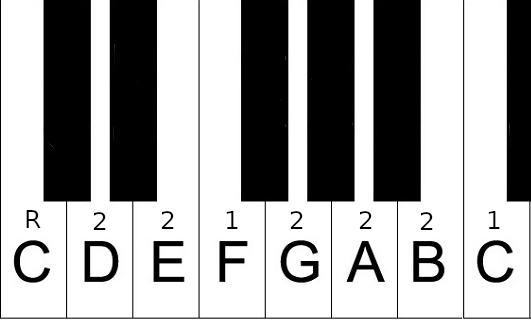
The C Major Scale (Key)
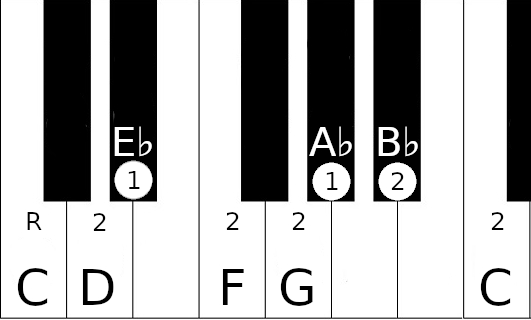
The C Minor Scale (Key)
What makes a black key a sharp or a flat?
The main things that causes the sharp or flat designation is alphabetical order and key signatures. We have already determined that a C♯ and a D♭ is on the same black key, which means there is no tonal difference between the two. It is in fact the same tone. However, when you construct the keys using the method above, you may get two notes using the same letter in the key lineup. Take for instance the key of F. When you work out the associated notes for the key of F using the rule of thumb that says “moving up means a black note is a sharp” will not be totally correct. The key would consist of F G A A♯ C D E F. There is no B in this sequence, but we have two A’s. when this happens, the A♯ will be called B♭ to maintain the alphabetical order. Just because we counted up from A doesn’t necessarily mean that it is an A♯. For this reason, sharps and flats may have identical tonality, but they are different notes in theory. Key signatures are the next thing to consider. Since F has a key signature of one flat, the sharp assignment simply cannot work. The one sharp key signature belongs to the key of G. Tonally A♯ and the B♭ are the same, but in theory you need to view them as different notes to maintain the key signatures, as well as alphabetical order. Also note that a key signature is represented either by sharps or flats. It is never a mix of the two. If one of the black keys is a sharp, they will all be sharps, and vice versa. Because of the semitone distance between E and F, the E can sometimes be referred to as an F♭ and the F can be an E♯. This also applies to B and C.
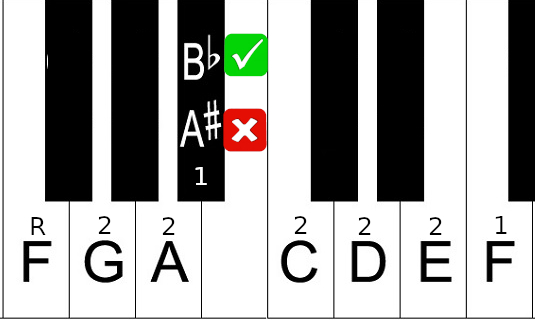
In this case we had to flatten the B rather than sharpen the A, so we can maintain the alphabetical order. When we look at chords, you will see that we always need to move down a semitone if we need to flatten a note, and we always have to move up a semitone if we need to sharpen a note. On the key scale, it is a different context though. We move up from the root note, but the actual assignment for a particular black note depends on the alphabetical order, as well as the key signature…
Double sharps or flats
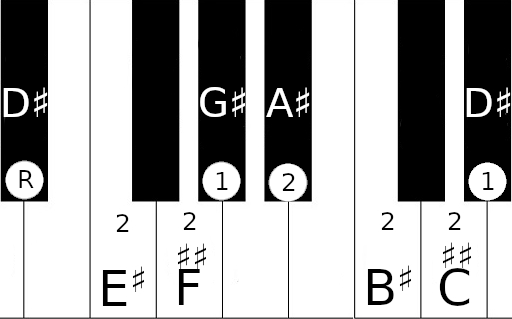
Because I don’t have aspirations to become some sort of music professor or a world famous concert pianist or something, I’m not going to list the double sharp or double flat keys. I will however just do a single example to make you aware of it’s existence and how they came to be. In the example below, we’ll look at the key of D♯ and its equivalent key of E♭. To make things slightly easier to explain, we’ll start on the E♭.
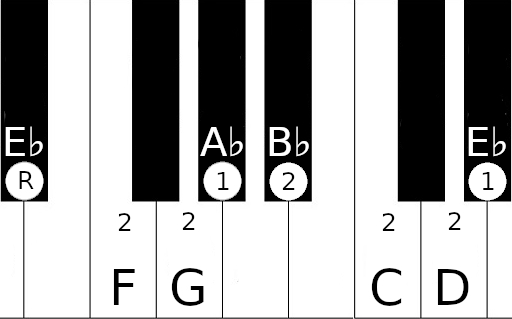
As you can see, there is no difficulty maintaining the alphabetical order using the required interval to create a major key while we are in the key of E♭. Remember that there is no audible difference at all between these two keys. They use the exact same tones. However, the double sharp has its place in the world of music.
Down below we start on the D#. The next letter we need will be an E, while the interval for the major falls on the F. Remember that F is only a semitone apart from E, hence we can also call it E♯. So the F becomes the E♯. The letter for the next note is where we run into real trouble. We need an F, but the F is occupied by the E♯. The actual F♯ does not correspond to the major interval requirement, so we need to sharpen the F♯ another semitone, which results in the G becoming an F♯♯. The same thing is happening with the B and C. In the end we can satisfy the interval requirement, and we can maintain alphabetical order using the double sharps. The double flats work in the same manner, just in the opposite direction from the originating note. However, this is the only instance you will ever see of this phenomenon on this site, as we’ll just use the tonal equivalent key which resolves without needing double sharps or flats.
Coming up next:
In the next post, we’ll take a look at chord construction and how they fit into the relevant keys…