
In this post we’re going to have a look at chord construction. If we look at a music piece like we do a painting, the key would represent your canvas, the chords paint the backdrop, and the melody provides all the details. Without chords, music might be only slightly better than a technicolor stick-man drawing.
The first level in chord construction comes from the key root. Once again we’ll use the key of C major to simplify things.
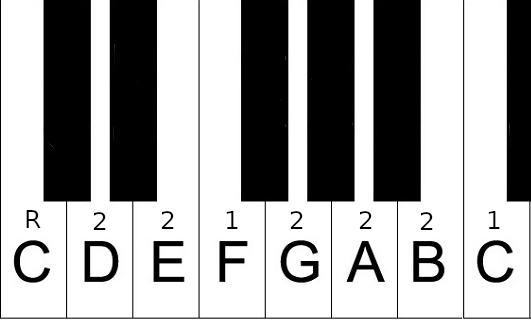
The C Major scale
We’ve established that intervals are the tonal distance between two notes. The physical size of an interval can vary according to the number of semitones that make up the distance to the next note. On the key scale we will refer to the root note (C in this case), and from there the intervals are numbered. The D would be the second interval (2nd for short), the E is the 3rd, and so forth.
Different combinations of these notes will result in different types of chords. If the root key is a major key, then so will the root chord be. The root note (C), together with the third (E) and fifth (G) make up the primary chord for the key. Because there are three notes in this chord, it is also called a triad. It does get more complicated than that, but we’ll address those complications as we come across them. The tonal distance of the third note from the root note in a major scale is two full tones (four semitones). In the case of a minor, the third note is flattened to an E♭, which has a tonal distance of one and a half tone (three semitones) from the root note.
A chord can be extended beyond the triad by adding notes. The opposite is also true. Adding to, or altering the chord pattern, will result in other types of chords. This can include augmented chords, diminished chords, seventh chords and so forth. For now, we are just going to stick with the basic major chord for the key, and move on to the next level of major and minor chords which are a part of the key.
Every note in the key is essentially the root note for chords that fit with the particular key. Both minor and major chords form part of the chord hierarchy in a key. In the major scale, the second, third and sixth intervals are always the roots for minor chords. The forth and fifth are the roots for major chords, and the seventh is a diminished chord (It has a minor third and a diminished fifth). For now we’ll set aside the seventh chord and only look at the major and minor chords. We’ll get back to the seventh when we look at the other chord types.
Stacking thirds:
| Maj | Min | Min | Maj | Maj | Min | Dim | |
| Key scale | C | D | E | F | G | A | B |
| 3rd | E | F | G | A | B | C | D |
| 5th | G | A | B | C | D | E | F |
Stacking third intervals is the same as using the third and the fifth intervals from the particular root, as the fifth interval is also the next third interval when you start from the third interval. In other words, the E is the third interval from the root, and G is the third interval from E. It is also the fifth interval from the root. In this table, the second row are all the third intervals for the chords, and the bottom row is for the fifth intervals.
If we take a closer look at the tonal distance of the third intervals (second row) for each chord we created, we can see that the second chord (D), third chord (E) and sixth chord (A) in the C major scale, all have a minor interval distance from their respective roots (three semitone distance on the chromatic scale). The third intervals for the fourth chord (F) and fifth chord (G) from the C major scale both have a major interval distance from their root notes (four semitone distance).
If you look at the intervals for the seventh chord (B), you’ll notice that its third has a minor interval from its root, and the fifth is also flattened. This chord is a diminished minor. When the fifth interval of a chord is flattened, it is called a diminished chord. If the fifth is sharpened, it’s called an augmented chord. If the fifth is in its normal position, it is called a perfect fifth. The seventh chord is not used very often, but the seventh note in the primary key do get used to extend the primary chord of the key root.
The minor scale:
| Min | Dim | Maj | Min | Min | Maj | Maj | |
| Key scale | A | B | C | D | E | F | G |
| 3rd | C | D | E | F | G | A | B |
| 5th | E | F | G | A | B | C | D |
Had we repeated the C major scale on the other side of the octave, you would have seen that the A minor scale fits perfectly on top of it, even as far as matching the major and minor chord sequence. We basically just cut the sixth and seventh intervals from the end of the C major scale, and stuck them to the front in the root position. That resulted in the R2122122 key interval. But remember, A minor is the relative minor of C major. They use all the same notes, but are rooted differently. Thus sequenced differently. As a result it sounds different when played from their respective roots. Also note that the inverse C minor and A major will not fit on either of these keys. And C minor is not the relative minor of A major. F# minor would be the relative minor for A major, and D# major would be the relative major to C minor. Move 3 semitones up from the minor to find the relative major, or move 3 semitones down from the major to find the relative minor. The relative minor is always the 6th of the major key, and the relative major is always the 3rd of the minor key.
If you understand everything up to here, you can already put together enough songs to keep you occupied for the rest of your life. Some of the more complex chords are useful for transitions and mood emphasis, but it gets more complex beyond the major and minor types. We’ll have a look at them individually if we need them for some specific purpose…