
To start off, we’ll assume that you know nothing about music, but you have at least seen a piano keyboard in your lifetime. If not, you can have a look at the handy picture down below.
It is important to note the difference between the mechanical keys of the piano, and keys in music theory as well. Both are referred to as “keys”. To avoid confusion, I will refer to the mechanical piano keys as “black keys” or “white keys”. In music theory the word “key” refers to a set of grouped notes that belongs to a particular root note and scale. It is also important to know the difference between a note and a tone. Notes have names like A, B or C, while tones are more closely related to pitch differences. A note can be a half tone (or a half tone away from another note), but there is no such thing as a half note (unless you refer to duration of a note in a particular measure). Still, they are all notes, even if they are sustained only for half the duration of a bar. But I’m getting ahead of myself here…
Music is made up from tones and semitones called notes, mixed together in a specific arrangement for the particular genre or style. Each note has a specific frequency relative to the notes surrounding it. A semitone (also called a half tone or half step) is the smallest frequency (or pitch) change possible between two notes. It is often referred to as the distance between two notes, which implies tonal distance, not physical distance. The technical detail of this may be explored in future articles, but falls outside the scope of this one. Just be aware that such a relation exists for now.
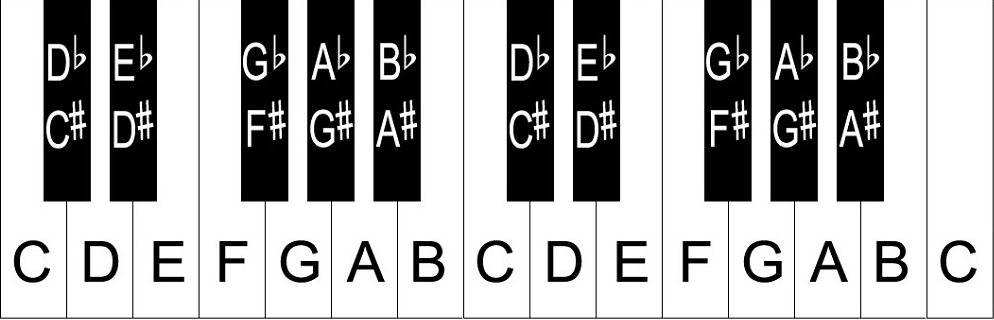
The notes on the white keys range from A to G with 5 black keys between them. This pattern repeats as we move up or down the keyboard. We’ll start off by choosing C as our starting point or root. The reason for this will become clear as we move along. Moving from C to the adjacent black key to the right of it, will increase the pitch by a half tone.
You will notice that the black piano keys have two labels on it. Raising a note by a half tone will result in a sharp. Hence when you move up a half tone from C, it results in a C-sharp (C♯). If you lower a note by a half tone, the result is known as a flat. Hence when you move down from D to the same black key, it results in a D-flat (D♭). Although C♯ and D♭ has the exact same pitch or tone on the exact same piano key, they are different notes in theory. The purpose of the double label for the same tone will also become clearer when we look at keys, scales and chord construction.
By now, you may have guessed that moving from C to D would increase the pitch by a full tone. Between B and C, as well as E and F are no black keys. They are only a half tone apart in either case. There are only 12 notes before the same sequence repeats from the next C on the keyboard. This is known as the chromatic scale, regardless of which note you start on. In our case we started with C as our root, and we will continue using C for a little while longer.
By now you should have the basic idea how tones, notes and tonal distance fit together in the grand scheme of things. Next we will take a look at keys and how they are constructed…